Archive for the ‘Michael’s Latest Gambling Yarn’ Category

Harry Wragg and the Brylcreem Boy

Posted on:

Harry Wragg and the Brylcreem Boy


This popular story, from Ripping Gambling Yarns was the very first of my short stories and goes back to an age before betting shops.


 I knocked twice on the dark stained door at the end of the passage.

A small hatch slid open.

“Oxo,” I said boldly, standing on tiptoe.

Alice let me in.

I entered the smoke-filled room where the usual crowd huddled around the ticker-tape machine, its stuttering chatter competing with the ringing telephones.

This is the back room of Charlie Young’s Hairdressing Salon and, as a chirpy, skinny ten-year-old, my excessive enthusiasm for racing and betting has led me to be accepted by all the regulars.


Today is both the last day of the 1946 Flat Season and the last day in the riding career of Harry Wragg, so consequently, my last chance to back him.

Harry was the thinking man’s jockey, known nationally as ‘The Head Waiter’ because of his effective waiting tactics. He had been champion jockey in 1941, and ridden the winners of 13 Classic races, including three Derby winners – Felstead (in 1928), Blenheim (1930) and Watling Street (1942). He also had two younger brothers, Sam and Arthur who were both successful jockeys in their own right.

Time running out, I quickly scribbled my first bet, 2/- win Tiffin Bell, (Harry’s first mount), and slid it across to Charlie’s lanky blonde wife Alice, who promptly secured it among 50 or so others in a giant bulldog clip.

“Two lumps today, Alice,” I piped, reaching for the obligatory cup of tea.  But before I had put the cup to my lips, Uncle Albert shouted across “Result Manchester – 1.15 – first Tiffin Bell – 5-2.”

“Blimey, I’m off to a good start,” I squeaked.


During the next 30 minutes, a pipe and two Capstan full strength passed through the security system and quickly contributed to the diminishing visibility.

Continuing my loyalty to H. Wragg, I invested 2/- to win on Aprolon in the next, and made myself useful by taking a tray of tea and biscuits out to Charlie in the shop.

Charlie, a dead ringer for Alfred Hitchcock, often used his ventriloquist talents whilst cutting hair.

“How’s it going young squirt?” he enquired, throwing his voice to the corner of the salon.

“I backed Tiffin Bell, won 5-2,” I boasted.

“Then you can afford a hair cut he replied,” still in the high squeaky voice.

“Sit in the end chair.”

Ten minutes later I re-entered the betting room sporting a well-slicked head.

“Aprolon won at 7-4 Michael,” Alice said, coughing manfully, adding “it must be your lucky day.”

“And Harry’s,” I said.

“What are you doing in the big one?” she enquired.

“Well, I’ve got to stick to Wragg now, but c-c-can I have a sub on my winnings?  I did have a shilling left over, but I had my hair cut.”

“Ask Taffy to settle up on one of your slips.”

“Bloody hell boyo,” said Taffy, “its like looking for a needle in a haystack.  Tell you what, I’ll lend you two bob until Monday.”

“Super,” I replied, and instantly returned the coin to his hand.

“Put it on Las Vegas in the N-November Handicap,” I stammered.

Two fifteen approached and the request for prices from the ticker-tape had the ring of an auction. Five to one Dornot – Rae Johnson; 100-8 Star of Autumn – Charlie Smirke; 20-1 Las Vegas – Harry Wragg.


Arriving just in time for the big race, I recognised the voices of Uncle Arthur (Craven A), and Uncle Henry (Rothmans), through the blue haze.  At this time, it was thought expedient by a health fanatic, to take the drastic step of opening a window an inch or two, as visibility had fallen to one pace, and it was difficult to hear the odds over the coughing.

Standing on a chair, Taffy shouted out “Under orders Manchester,” shortly followed by “Off Manchester 2-20.”

A stillness now came over the assembly, and strangely, the absence of a running commentary in no way diminished the excitement, as each man prepared himself for the instant finality of the result.

The silence was finally broken by the sound of the ticker-tape. Taffy crouched over it assisting its passage like a midwife at a birth.

“Here it comes,” Taffy warned … “Manchester – 2.15 – first, Las Vegas 20-1, second, Delville Wood 33-1, third, Star of Autumn….”


At this point Charlie, burst in shouting “Quiet everybody, quiet, I’ve just seen two coppers hanging about outside – there’s going to be a raid – everyone upstairs, quick as you can.”

Charlie then went into his raid-drill, “Alice get rid of the ash-trays, Taffy give me the cash and the books, and put the ticker-tape under the stairs, NOW!”


A crocodile of disgruntled men climbed the stairs to temporarily pay their respects to Alice’s bewildered mother, Violet.  Meanwhile, Charlie beckoned to me, “You come with me boy.”

“They’re at the back door Charlie,” Alice cried out.

“Hold them up for as long as you can,” he replied, then staring close into the faces of two bemused customers, said, “You’ve seen nothing, OK – and your haircuts are on the house.”

“Michael, put the plank across the arms of that chair, and sit up on it.”  I obeyed instinctively.  Charlie then put the books, cash and betting slips into a pillowcase, pushed it under the plank and threw a large white cape around me to cover everything.


“Afternoon Mr Young.” The stentorian voice preceded the presence of two uniformed police officers.


“You’ve been very busy this afternoon.”

“Yes, usual Saturday afternoon you know.” Charlie replied, looking a little pale.

“Alice looks as if she has been washing up cups for an army,” the sergeant added sarcastically.

“Customers like a cup of tea with their haircut you know.”

“Yes of course, we must try that approach down at the station,” he retorted.

“Given up the betting, have you Charlie?” he persisted.

“Yes, a mug’s game really you know officer.”

“You’d be a mug if you got caught Charlie – a heavy fine could close your business down.”

“Yes officer, but all that’s in the past now.” said Charlie, riding his luck.

The sergeant’s gaze turned to the customers.

“Been waiting long, gents?” he probed, but their nervous mutterings revealed nothing.

Looking in the facing mirror, I watched the copper slowly circle my chair.

Until, “This boy’s nearly done.  Perhaps as a favour you could cut my hair next.”

I could feel my heart beating – my winnings were in that pillowcase.

Suddenly, I blurted out,

“Ch-Charlie’s got to wash it first, officer, I’ve only just got here.”

Charlie’s blanched face sprang to life.

“Yes, course I have. His Mum hates all that Brylcreem plastered all over it.”


Terrifyiingly, I felt myself propelled forward to the basin for a vigorous hair washing.  This, having been done under the sergeant’s steady gaze, Charlie was then obliged to begin my second haircut of the afternoon.  As the sergeant’s puzzled frown deepened, Charlie explained helpfully, “His mum likes it short!”

“Oh well, must be getting along, I suppose.” The sergeant slowly moved towards the door before pausing.

“There’s just one thing you might like to help with Charlie,” he said thoughtfully.

“Of course officer, anything,” said Charlie obsequiously.

“I’ve got ten tickets left for the Police Dance next Saturday, would you like to take them off my hands?  Be good for you and Alice to get out occasionally.”

Charlie gritted his teeth and paid up.


Leaving by the front door the two policemen were joined by Uncles Arthur and Henry tiptoeing down the stairs from the now profoundly bewildered Violet.

“What are you two up to – leaving the scene of the crime?” questioned the sergeant.

“No officer,” said Arthur, “we’ve just been estimating for a wallpapering job.”

“A cover up job, more likely,”


As the story of this raid went around Woking, so I became the boy hero, albeit with the shortest haircut in Surrey.


To celebrate the 80th Anniversary of VE day 1945

Posted on:

Michael takes a light hearted look back to his wartime memories


Taking Cover

“Come on Michael, we’ve got to get under the table.”

“But Mum, I haven’t finished eating my boiled egg.”

“Never mind, bring it with you.”

The air raid siren wailed out from the top of the Co-op building at the end of the road. And although in the spring of 1940, alarms like this were not frequent in Woking, in the following months they grew to become a regular occurrence.

On more than one occasion my mother would run outside and hold me up to see a stray German plane and a British fighter engaged in what was known as a dogfight. One such dogfight took place high over Woking Railway Station, drawing a large crowd below. A railway porter told my mother, that ours was a Hurricane and theirs a Messerschmitt, and a great cheer went up, when after many minutes of combat the Nazi pilot was seen off.


That summer, late one night, a returning German bomber passed low over our bungalow accompanied by a loud whistling noise and a crunching thud.

I can remember the crushing feeling of my father throwing himself on top of me, followed by a lot of shouting. Eventually, when everyone had calmed down, Dad and Mr Powney, from next door, bravely went out into the back garden with a torch to look for the unexploded bomb.

Strangely, nothing could be found, so Mr Powney, a fireman, quickly cycled off to the Fire station to report the incident. Later, when bells and sirens filled the air, a fire engine appeared on the other side of the canal, directly opposite our back garden, where they found the unexploded bomb had taken the corner off a nearby house

As a result of this close shave, my father, who was expecting his call-up papers any day, decided to move the family to Wales. My Nan, who lived with us, knew of her brother-in-law in Llandrindod Wells, and thinking he would help us and the war would be over by Christmas, we packed a few things into a couple of suitcases and walked to the top of the road to catch the bus.

It seems I was a little difficult, and not content in just taking my teddy bear, insisted on carrying a small metal case filled with tin soldiers. In the 200-yard walk to the bus stop the inevitable happened; the case proved too heavy for me to carry and, my Nan, who had vehemently protested against me bringing it, ended up by carrying it herself. A story she repeatedly told, whenever I got my case out to play soldiers.

After an arduous two-day bus journey, we finally located the Llandrindod Post Office. To our despair, they had no knowledge of Nan’s brother- in-law, neither was he on the electoral role.

Coming out of the Post Office we witnessed an open-top car speeding through the town centre, urging everyone to take cover and sounding a portable air-raid siren.

“Out of the frying pan into the fire,” my Nan exclaimed!


The next day, after a night of discussion, on whether we should return to Woking, we were informed of the reason for the siren’s failure – a strategically built blackbird’s nest. What’s more, it had proved to be a false alarm.

Having now convinced ourselves that Llandrindod was a safe refuge from the German bombs, the portable siren that sounded our arrival, was in hindsight, the only alarm raised during our five-year stay.


Our first lodgings were two rooms close to a railway level crossing, about a mile out of town. Soon after moving in, my Dad’s call-up papers arrived and from his joining the Royal Artillery as a gunner, we were not to see him again for six months.

Meanwhile, my mother got a job in a grocers, I was packed off to school at the early age of four, while Nan was left at home to do the cooking, washing and ironing.

My school, a mile from home, taught pupils between five and 14 years (school leaving age), in a single stream. This meant that pupils advanced solely on ability, resulting in some classes containing children both a year older and, a year younger than the majority.


In my first term as “the four-year-old cockney boy”, I was regarded as a novelty, especially when I sometimes arrived in the milkman’s pony and trap after thumbing a lift to school. At the Christmas school concert, to the pleasure of my Mum and Nan, though embarrassing for me, I was brought centre stage and put between two girls to sing “Away in a Manger.”

The following year, my “quirkiness” reached a peak when I announced to the class that Father Christmas was really your mother or father dressed up. For my punishment, after loud jeering from my classmates, was to be kept behind for ten minutes. However, when all had gone, my teacher told me this was to be our special secret and allowed me to run along home.


Looking back, I seemed to be in and out of trouble regularly. There was the time when I skipped class to take Gwenyth, the headmaster’s daughter, to the local cinema’s matinee performance of Robin Hood. We were both six years old. Then on a parents open day, I proceeded to walk about with a cardboard sign strung around my neck with MURDER written on it in big red letters. Little did I realise that spelt backwards it read RED RUM.

As recompense for these misdeeds, I was given the 23rd Psalm to learn in Welsh and during one scripture lesson was brought to the front of the class to recite it. Surprisingly, to me, half the class were unable to speak Welsh, and so, thereafter, I was referred to as the English martyr.

Living in two rooms had been quite difficult. It was a small house anyway, with a shared kitchen, an outside lavatory and no bathroom. Friday night was our bath night, skilfully managed by my mother in front of an open fire, with a tin bath, kettles of hot water, a big bar of Fairy Soap and a large fire screen for decency.


Months later, when my father eventually got a 72-hour pass, he arranged for us to move into a two-bedroom house about half-a-mile away. But the day of moving was far from joyous. Loading our few belongings onto a hand cart we were followed by the local children chanting, “London cockneys ain’t no good, chop ‘em up for fire wood.”


The new lodgings in Tremont Road gave us more room, although since Mum and Nan occupied the two bedrooms, I slept on a sofa in the front room, enjoying the remains of that day’s coke fire. Additional coke supplies (solid fuel) were obtained from the back of the coke factory, where Mum would fill up the well of an old pram and sit me on top.


The warmth from the embers of the fire late at night may have protected me from the severe bout of influenza, which my mother and Nan were to suffer.

Later on, in one of the worst winters in Wales for many years, I was to push the old pram through the snow to get the family shopping.

Food had been rationed since the beginning of 1940, but not offal, so providing we could afford it I was able to come home with an assortment of liver, kidneys and sheep’s brains, the later a war-time delicacy that I would describe in the playground to squeamish girls. Fish, apart from snook and whale meat was very scarce, but Freddie, a close friend of my Mum’s workmate Emily, would occasionally drop in a fresh salmon that he had poached from the river by torchlight.

Freddie certainly came up trumps the following Christmas, making me a large scale fort with turrets and a drawbridge. Lead soldiers were now very scarce, but I remember my father coming home with a beautiful set of Scots guards, charging with fixed bayonets and, a model of a Spitfire carved in wood by his army pal.  These were high times for me, preceded and followed by what we would now call deprivation.


 A Letter from Dad and a visit from Auntie Mary


Letters from a loved one during the war were rare and unlike the emails of today, were regarded as a cause for celebration, to be treasured and reread many times. Also, incoming telephone calls were virtually non-existent, since very few people had a telephone in their house.

Eventually, my mother learned that Dad had been posted to the Royal Artillery unit on Drakes Island near Plymouth. His letter told us he was in good heart, despite having to man the big guns that followed the searchlights at night, then sleep on the ammunition during the day. Not all his letter was readable though, for the troops mail was read by an Army censor who would run a thick blue pencil through any location or sensitive information.

During the following summer my Auntie Mary and her year-old baby Peter came to stay with us. Mary had wanted to get away from the doodlebugs (V1 rockets) that passed over Woking every night and told us how she had made a nightly home for her and Peter in the large cupboard under the stairs. Her hideaway was furnished with a single mattress and pillows, together with a card table on which she kept a pot of tea, a packet of Craven “A” ciggies, Peter’s bottle and the latest Daphne du Maurier novel.


Her husband, Henry, meanwhile, worked the nightshift at the nearby Vickers munitions factory.

On one occasion, whilst cycling to work across the airfield, a stray German plane flying very low scattered the workers with a burst of machine gun fire.

Strangely, on the two occasions she stayed with us, after the first week she would tell us that it was really too quiet for her and she ought to be getting back to see Henry and hear the local gossip.


Llandrindod and the neighbouring towns were “Strict Chapel,” while Mary, an ex-barmaid was appalled by the closure of public houses and the railway station on Sunday.

“I don’t know how long I can stand it,” she would say pleadingly to my mother. But she did for about a month, until she claimed, she was deafened by the silence.


It was a wonderful surprise when the following summer, Dad was posted to Swansea. And after settling in, he booked us into nearby rooms for a month, having received permission to lodge with his family in the evenings.

Swansea itself was just getting back on its feet after a continuous blitz from German bombers; the town centre and most of the surrounding area having been completely flattened.


This was the first seaside holiday I can remember – bareback horse riding on the beach and the excitement of a local Donkey Derby remain with me to this day. Sadly, the time passed all too quickly and we never saw much of Dad again until he was demobbed over a year later.


Meanwhile, back at school we were encouraged to bring in small tins to receive allocations of dried eggs and cocoa. And as the allied troops got ready for “The Big Push,” so our playground war games became more exuberant.  I kept a map of Italy and Germany on the wall above my bed, marking in the allied attacks and German panzer movements with red and blue crayons.


On the May 8, 1945, my mother’s birthday, people came running out into the street to celebrate our “Victory in Europe” or VE Day as it became known.

A week later, running through an ally at the back of our house with a toy machine gun, a neighbour looking over the wall shouted out, “Put that gun away Michael, the war’s over,”

“Not yet Mrs Llewellyn,” I replied, “We’ve still got to beat the Japs,” and fired an imaginary burst of bullets into a hostile bunker, which in reality was a cold-frame of rhubarb!

Three weeks later, rent paid and goodbyes said we were on our way back to Woking. And Nan having bought me a large cardboard suitcase in which to put my dismantled fort, made sure it was I who carried it.      

Returning to Woking after our war time evacuation was not all we had hoped for. The couple who my father had rented our bungalow to, had not only left owing three months’ rent, but had removed all the internal doors to use as firewood and, kept coal in our bath.  To cap it all, the agents employed to collect the rent had left town with no forwarding address.  Even so, despite all these inconveniences, we all agreed it was great to be back


In celebration of our return, our first family reunion took place on the Sunday before the 1945 Derby. And introduced to five of my Dad’s eight brothers, who seemed to be there solely to discuss the race, my life was irrevocably changed.


James Hillman author of The Souls Code would call this moment an annunciation – “This is what I must do, this is what I have got to have. This is who I am.”

I still retain the vivid memory of that morning, when all the talk was of the forthcoming Derby. My impressions and senses were quickly swamped by their enthusiasm and amid the smells of beer and Woodbines, the magical names of the horses: Dante, Midas and Sun Storm and the famous jockeys: Billy Nevett, Harry Wragg and Gordon Richards, would in time become as familiar to me as my school mates.

Uncle Henry made a valiant effort to discourage me, saying it was all a mugs game and that he had never backed a winner. But it was all quite useless, for I took to racing like a duck to water, as readers of this website can now testify.


************************************************************

To see Michael’s interviews go to the foot of About Michael


Lord Gyllene’s Monday Grand National with Father Green

Posted on:

The 1997 Monday Grand National

Grand National racecard 1997


  Father Green had been reading in the Press that the up-coming 1997 Grand National was to be the 150th running. This year’s race looked wide open and in Perry’s words, “Was not to be missed.”


Although he had previously booked his County Stand Badge, how he would travel to Liverpool and, whether he would stay up there for more than a day, he had yet to decide. Then strangely, on the Monday, he received a call from a long lost friend, Father Tod Abraham.

“This is a surprise, after all this time too. What’s been happening?”

“Well, remember old Tom Tooley from our seminary days? He and I were talking about the Grand National and your name came up. We were remembering how you loved the race and the good times we had at Aintree. So, we thought, why not do it again?”

“It took me a couple of days to track you down on the Catholic radar, but now that I’ve found you, what do you say?”

“Count me in,” said Perry, enthusiastically and straight away agreed to share their Aintree B & B.

“We’ve booked it Wednesday to Wednesday,” said Tod, “so, Thursday to Saturday we’ll be racing and the rest of the time acting like tourists.”

“There is just one thing Perry, I’m told there are only two single beds and, the living room’s quite small, but there’s a large settee which makes up into a bed, if you don’t mind sleeping there?”

A short silence followed, after which, Perry, ever conscious of his six-foot-four-inch frame, answered bravely, “Oh that’s fine, really it is.”

The conversation then drifted to old seminary days and some uncomfortable memories for Perry, as Tod touched on the late night poker school in which Tom Tooley claimed he had lost a tidy sum to Perry, who had bluffed the pot with a pair of three’s.

Perry sighed – “Ah, the stuff of legends,” but then quickly and diplomatically ended the call with, “It’ll be fantastic to see you both again, let’s hope this year we get the winner.”


For the rest of the day, Perry seemed a little reflective. He had really only planned to go to Aintree for a day or two, but somehow, he’d got carried away in the excitement. Emily, however, having overheard part of the conversation and unable to bear his indecision any longer, came up with the following suggestion.

“Father, why don’t you ring Father Abraham and tell him you’ll be travelling up early on the Friday morning – Euston to Lime Street – drop your bag in at their B & B and then go racing?”

Arriving at Aintree racecourse, Perry felt a surge of excitement. It looked like a fair size crowd for the Friday and although the weather was overcast and grey, he was very glad to be there. On meeting up with Tod Abraham and Tom Tooley, he learned that Tod had heroically relinquished his bed to him during his stay and now, he looked forward to two days’ racing.

Father Green His betting, however, could have gone a little better, having backed The Last Fling, second to Cyborgo in the Mildmay, and then Highlandman, second again, to Blue Cheek in the Fox Hunters. Never mind this was like a holiday to Perry and he was determined to enjoy every minute of it.

The following morning, after a hearty breakfast of ham and eggs, he left his fellow priests to take the Racing Post back to his bedroom in anticipation of the afternoon’s sport – this was the time that he loved best.

Arriving on course, the view from the County Stand was exhilarating. High in the stand he was opposite the winning post and, with his binoculars and view of the big screen he hoped to follow the big race throughout.

Perry’s luck, however, was still absent without leave – the first three races returning winning S.P’s of 25-1, 20-1 and 14-1 – so filling the bags of almost every bookmaker to the brim. Only a popular National winner would remove the hurt of some 60,000 spectators on course and a further ten million punters at home.

Then, with the horses coming into the paddock, the Merseyside police received a coded warning that a bomb had been planted at Aintree. Nigel Payne, Aintree’s Press Officer, broke the news, live, to BBC’s anchor-man Des Lynam and immediately after, loudspeaker instructions were broadcast to evacuate the course. In addition, as part of the security operation, racegoers were forbidden to remove their vehicles from the car parks for the remainder of that day.

Meanwhile, the search for the bomb continued.

Jenny Pitman, a previous winning trainer, made a tearful plea to Lynam:

“We have the lunatic element here and we can’t give in to them.”


As the gravity of the situation became known, the Managing Director and Clerk of the Course, Charlie Barnett, confirmed that two coded bomb warnings had been received and with the minimum of decorum, asked Lynam and the BBC to leave Aintree immediately.

At this point, Father Green, and those around him, still hoped that racing would continue later. However, the sight of tens of thousands of people spilling out onto the course and a few hooligans clambering over the fences, caused that hope to disappear, leaving only a painful memory of the day that had promised so much.


Being six-foot-four sometimes has an advantage, for although Father Green was hemmed in against the running rail, he could at least see where the meandering mob was heading.  Similarly, those within shouting distance could

see the tall figure of a priest in a Homburg, trying to move through the crush without forcefully pushing or shoving.

“Father Perry, Father Perry,” a strong Irish brogue cut through the dejected babble and soon, Tod, Tommy and Perry were reunited.


Later that evening, when Tod went out to get a Chinese takeaway for them all, he was delighted to hear from Larry Wong that the National was to be run on Monday at 5 p.m. – the only race on the card.

In the meantime, Perry had nipped out to buy a bottle of Glenmorangie whisky and six cans of Guinness. It was going to be a good night after all.


It was some time after the three men demolished their Chinese supper, and only then, as an afterthought, Tommy enquired, “Does anyone fancy a game of cards?”

“I found an old pack,” Tommy continued, “in the chest of draws in my bedroom – they’re all there, I’ve counted them, what do you think?”

Tod looked a little uncomfortable at first, before referring the question to Perry.

“You’re the expert, so they tell me. What should we play Perry?”

“Five-card brag can be fun. It’s a simple game,” he said airily, “you are dealt five cards each; make a hand with your best three and throw the other two away. Like poker really, but a run beats a flush. Oh, and a A-2-3 beats a A-K-Q,” he added, nonchalantly, “that’s usual I believe.”

They decided to play for 50p stakes and since none of them had much in the way of change, Perry found a full box of matches by the gas fire to improvise as chips.

Tommy and Tod both remembered playing 3-card brag as schoolboys, so having two further cards to choose from felt like a luxury.

After half-an-hour, with the game heading towards boredom, Perry made the suggestion that they open the Glenmorangie. Not surprisingly, the game took off.


Tod was the first to get a really good hand – a 6-7-8 all in spades. Tom and Perry went with him for a while, till Tommy threw in. But Perry, for reasons best known to himself, stayed in longer than perhaps he should. Tod picked up around 20 matches and looked very pleased.

As the night went on and the whisky went down, so the stakes grew bigger. In fact, Tom found it necessary to knock on the landlady’s door for another box of matches. Then, as so often happens with this game, all three men drew exceptional hands at the same time. Tod picked up three Kings, Tommy a Q-J-10 of Diamonds and Perry, well, we’ll have to wait to see his cards.

Needless to say, each player thought they had the winning hand and when the matches ran out, apologetically, but nevertheless enthusiastically, fivers and then tenners took their place.

After ten minutes of building up a sizable kitty, each player was faced with the strong possibility that there might be a better hand than their own. And whilst Tom had liberally contributed, he was the first to crack, and threw in.

Thereafter, Tod and Perry continued to bet as if their money were only lent, until Tommy counted the kitty as nearing £150. At this point, they braced themselves with another whisky and tried to take stock.

Tod could not believe that Perry had three aces and although happy with the original 50p stakes, he now felt the need to press on, quietly harbouring the thought that it would teach Father Green a lesson.

Perry, too, took stock and slowly developed the face of a gravedigger – but whose grave was he digging?

Ten minutes later, with the kitty up to £250, Perry paid his final twenty to see Tod’s hand.

“Read’em and weep,” Tod said joyfully, having remembered the phrase from an old movie, and then spread his Kings out in front of Perry.

There followed a short silence, until Father Green slowly tipped over his cards – three fives!

“What a relief,” said Tod, “Thank heavens for that.”

But it was Perry who scooped up the money.

“Sorry Tod, but three fives is the top hand – just like three-three’s in three-card brag.”

Tod’s face was a picture of disbelief, until Tommy backed up Father Green.

“He’s right Tod, remember when we played three-card brag as kids and you won my wristwatch with three three’s.”

Tod regained his composure, while Perry folded the notes into his pocket.

“Well, I really have to thank you both,” Tod said unconvincingly, “you have taught me a valuable lesson, one, I should have learned long ago.”

Then, with a noticeably croaking voice he enquired, “Say, is there any more of that fine scotch whisky left?”

Sunday morning, the three of them trooped off to Hope Street to hear the 11 o’clock Mass at the Metropolitan Cathedral of Christ the King. None of them had visited it before and so when the crowds had gone they took time for a personal tour. Towards the end, Perry read the first lines of a poem written by a local newspaper editor on how the people of Liverpool had built the Cathedral.


   “They did it by touting the streets and pubs and knocking on doors like their own.

  They did it, bless ‘em, by giving, when they had so little to give.”


As they were about to leave, Perry excused himself, saying, “I’ll catch up with you boys.”

Tod and Tommy then surreptitiously watched him engage one of the priests and pass him a bulky envelope.

Later when out in the road, Tod asked, “Where did you go Perry?”

“Oh, I just went to slip the priest a couple of quid.”


*     *     *     *     *     *     *     *     *     *     *     *     *     *     *     *     *     *


Monday’s Grand National was due off at 5 p.m., the time set to encourage as many locals as possible to attend. It was a fine day and Tod, Tommy and Perry, joined the large crowd with a spirit of Dunkirk defiance, as the 36 runners went to post.

Go Ballistic (fourth in the Cheltenham Gold Cup) and the grey, Suny Bay, headed the market, whilst the New Zealand bred Lord Gyllene was a popular each way choice at 14-1.

My own recollection of the race at the Raynes Park offices of Racing Post was that work stopped completely, while staff gathered to see courage and tenacity triumph in the face of adversity.

Back at Aintree, Lord Gyllene, under the joint bottom weight of 10 stone, made virtually all the running to win by 25 lengths from the gallant Suny Bay, with the 100-1 shot Camelot Knight, third of the 17 finishers.


That evening, Tod, Tommy and Perry tucked in to large portions of steak and mushroom pie, washed down with pints of Guinness, until finally, Perry’s taxi arrived to take him to Lime Street Railway Station.

They all agreed that in spite of the disruption, they’d had a great time and promised each other to do it all again next year.

“But, with some other card game, aye,” said Tod, with feeling, as he carried Perry’s bag to the door.


For more racing history see Michael’s Books for Sale. 

To see Michael’s interviews go to the foot of About Michael


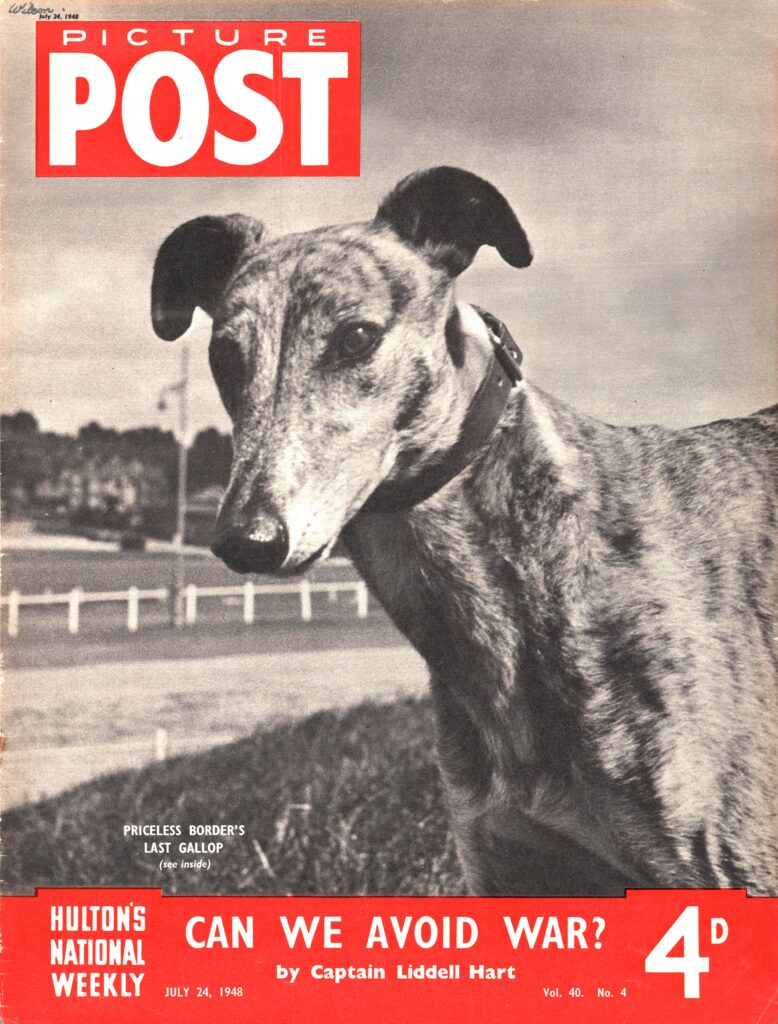
Priceless Border – The World’s Fastest Greyhound

Posted on:

The World’s Fastest Greyhound


Little did I know as I queued in front of the new Woolworth’s weighing machine in the summer of 1949, that I would remember the next minute for the rest of my life?

The eager queue of school children waiting to weigh themselves en route to Saturday morning pictures, were not there to monitor their progress against under-nourishment, nor to measure obesity, but simply in order to obtain a weight-card in the highly collectable series, ‘Speed’.

Among the cards I had seen at school were ‘The Flying Scotsman’, the racing driver Malcolm Campbell, and the Olympic athlete Fanny Blankers-Koen.

To this 13-year-old they looked exciting, up-to-date and a change from the previous cigarette cards.


I put my penny in the slot and waited. My weight on the card – 8st 6lb, was of little interest, but the picture was – a brindled greyhound in a red jacket at full stretch.

It read, ‘Priceless Border – Greyhound Derby Winner 1948 – approx 37.3 mph.’

I had another penny left, but with the kids behind me shouting ‘hurry up Churchy, jump off’, I complied – only to jump smartly back on to weigh again. ‘Hallelujah! Another Priceless Border! What are the odds of that?’ I said to the next in line?


Priceless Border was well known by my school mates, some having backed him. And I could remember, reading in the Greyhound Express, about him winning a heat of the 1948 Greyhound Derby in 28.64 sec – a world record for 525 yards – before he went on to win the 1948 Final.

On a day dream level, I learned he was owned by a 10-year-old boy, Desmond O’Kane, his father having bought the dog for £110 as a present for him.

From that moment on, I saved a weekly amount towards my first greyhound.


The strange thing was that no-one else at school, no matter how many times they weighed themselves, ever got a Priceless Border. And it got to the point that a few doubting Thomases’s, including Bobby Reigate, who only needed that card for the set, continually heckled me into bringing one of the ‘Priceless’cards to school.


During the next day’s dinner break, I enjoyed the notoriety and the bargaining power of being the sole owner of these rare cards. The gathering crowd of enthusiasts inevitably broke up into scuffles, attracting the attention of the duty dinner teacher Ma Frost.

Fearing the card could be confiscated; I quickly switched it for the less valuable cigarette card of Don Bradman and, under duress handed it over.

Later that day, I stoutly refused all overtures from Reigate for the precious card, until he hinted darkly that he would, in future, make me an offer I couldn’t refuse.


Reigate continued to harras me until two months later, when there was a knock on our front door. It was Bobby Reigate and his father.

My Dad, unaware of the significance, invited them in and Mum made them tea. It ensued that Mr Reigate was taking Bobby to see Chelsea at Stamford Bridge and asked if I would like to share Billy’s birthday treat?

‘We could stay after the match for the greyhound racing’, he added.


I had to hand it to Bobby; this was an offer I couldn’t refuse. But, wishing to look cool, I sat very still and pinched my leg, until eventually, politely thanking Mr Reigate. Strangely, nothing was said about the Priceless Border card, but with schoolboy honour I knew my duty as one obsessive to another.

Going into the front room I took one of Mum’s ‘get well soon’ cards, wrote Happy Birthday Bobby and dropped in the ‘Priceless.’


More than 60 years later, and by now my prized weight-card long gone, a strange coincidence took place. One evening, on entering ‘greyhound’ into eBay, up popped an original Priceless Border weight-card. Joyfully, I bought it, but that’s not all, for when the card duly arrived I turned it over to see the date – July 49 and, the weight 8st. 6 lb – what are the odds of that?


To back-up my story of the popularity of this greyhound see below the cover of Picture Post, the top selling magazine at the time.


For more racing history see Michael’s Books for Sale

The First Levy Board Experience

Posted on:

The First Levy Board Experience


It was snowing big flakes as I walked down Oxford Street in search of a job.  I had been unemployed for three days and was looking for the Brook Street Bureau.  Shortly after being told, “It’s about 30 yards along on your right,” I spotted a pound note on the ground, trodden in the snow.  Picking it up by the Bureau entrance, I went inside, hoping to play up my luck.


It seemed that the newly formed Horserace Betting Levy Board were in need of clerks who were good at maths, knew a bit about racing and had preferably worked for the Government. And so, deemed fit for purpose, after the first month, I was given a rise and put in charge of the Assessments Division.

The task, after the legalisation of Betting Shops a year and a half earlier, entailed assessing and collecting monies from bookmakers and the Tote, for the purpose of improving the panorama of horseracing.


The staff employed, roughly fell into three categories – ex-army personnel, their daughters, and ex-civil servants.  For a while, the daughters   (rarefied breeds), were allowed to keep their pet dogs (rarefied breeds), under their desks, and this perk seemed to catch on, until dogs of different persuasions confronted each other.  Then the posturing, growling and barking would inevitably bring their owners into the fray in an attempt to separate their charges.  However, these ‘teething problems’ were soon sorted, when both ‘Peek’s’ and perks were withdrawn.


It didn’t take me long to discover I was the only member of staff with a Secondary Modern education, and there were times when I was more than a little embarrassed, although, a few of my colleagues also came from unique backgrounds. Gerry, who had studied to be a Cistercian monk in Ireland, was unable to keep silent either then or now. There were two Hugh’s – ‘Hugh the cash’, who was the chief cashier, and ‘Hugh the books’, who kept track of the ‘non-payments’.  Both were brought up in the village of Bedgellert, in darkest Wales, and in times of high excitement, reverted to their mother tongue.


At the time, everyone shared a great enthusiasm for the work, but none more than Dennis, who would make the return trip to Angmering in Sussex every day on a moped, having first purchased The Sporting Life at 6 am.  By contrast, Anne – a voluptuous young lady who, in the process of calculating horse transport allowances, was often to be found lying in the middle of the floor on a huge map of Britain, inviting passer’s by to come down and help her find the way from Bridgwater to Bogside.

Another lady who left a vivid impression was the formidable Miss Hardcastle, who ran the Registry. A forerunner of Ann Robinson, who, peering over her spectacles could discharge a volley of cutting remarks that would bring a Brigadier to his knees.


Of course, harnessing these diverse personalities was sometimes a headache, but I had no difficulty in organising the daily Naps table, encouraged by the hierarchy “to spread a wider understanding of the sport among the staff.”  This unfortunately they lived to regret, for its inroads into the workload were significant, firstly the deliberation over the selections, secondly because of the necessity of keeping the master sheet up-to-date, with all its pluses, minuses and disputes, and finally, the collection of money each week, all of which left very little time to fit in the work.   However, it did generate a lot of fun and a nail-biting finish on the final day, with Dennis, myself and Gerry leading at different times in the afternoon, and Gerry celebrating his last race triumph with an exuberant Irish jig on the top of his desk.


A few weeks later on, December 21, 1962, there began a lengthy period of bad weather known as ‘The Big Freeze’.  Only one race meeting took place (Ayr, January 5), before racing resumed on March 8, and the effect on both betting shops and the Levy Board was devastating.


With the bookmakers’ payments down to a trickle, the staff was left in a void, and more so, after a well-timed directive closed the Naps competition. Nevertheless, we all came to work as before.


Now, inventive activities filled the time. To begin with, there was pool betting on the first word uttered by the tea-lady as she entered our office with her trolley, but since she had a colourful vocabulary, there were many rollovers.  However, this was such a success that an afternoon version was added.  I’m sure the poor woman often wondered why her opening greetings were met with such mixed reactions from the staff.

Then of course, there was the paper dart in the hat game, paying even-money at three paces.  Another stimulating challenge was betting on the number of minutes between red buses stopping outside St Pancras Church.   This activity kept the two Hugh’s happily occupied at their window desks for the best part of the afternoon, and could surely be claimed as the forerunner of spread betting.

The usual diversions such as Pontoon, Poker Dice and Totetopoly were, for reasons of decorum, played in our extended lunch break, whilst some of the more restless of the staff would prefer to catch a cab to a nearby Dance Hall to improve upon their Twisting or to learn the ‘Locomotion’.  And so it was that many happy hours were passed throughout that winter.


Sadly, all this came to an end when racing resumed; that is until Gerry devised a novel Grand National competition. As soon as the weights were published, he encouraged each person to put a cross against their fancy and put two shillings in the kitty.  This was repeated every week until the big race, when the horse with the most crosses carried all the money in one huge, each-way bet.  Gerry’s Cistercian logic was that if we were lucky, we could all celebrate together.  Anyway, despite all that, Gerry let the ladies persuade him to divide the kitty between the top two horses.  Thus it was that we went down to the bookies with our crock of gold and backed Frenchman’s Cove and Mr What each way.


Leaving a friend’s wedding early to watch the race on Mum’s TV, a mile and a half away, I was grateful to those cautious ladies, as Frenchman’s Cove, our first choice, was brought down, while Mr What finished third at 22-1, to Kilmore and Fred Winter at 28-1.


Throughout this year and the next, for a number of reasons, the Levy collected fell critically short of expectations, and I was gently persuaded to move on.   My fond memories of this happy time have now mingled with the reflection that I was possibly not quite mature enough for the job!


The Ghostly Lieutenant

Posted on:

The Ghostly Lieutenant

Father Perry Green and his housekeeper, Emily, having spent the morning taking down the Christmas decorations, were carefully wrapping the crib figures in tissue paper and boxing them up for next year.

The tree had been a bit of a problem – an artificial, three-part, screw together, measuring eight feet high. Not Father Perry’s idea, but Emily had insisted, “I haven’t time to hoover up pine needles for the twelve days of Christmas.”

So now, having forcefully crammed the tree back into its original box, it joined the other packages on the landing, waiting for Father Perry to put them in the loft.


A few days later, not having visited the loft since moving into his new residence, Perry was keen to tell Emily what he had found up there.

  “It’s terribly dusty, nothing has been disturbed for years – rolls of carpet, tatty curtains, old picture frames; no lights of course, but there is a skylight window and under it, there’s a card table, a wicker chair and a pile of old newspapers. It looks as if many years ago someone went up there to study. Oh, and I think we might have mice too. I will have to ask the council to send around the pest controller.”


The following Saturday, there was jump racing at Ascot on TV.

Father Green had come back with the Racing Post and was looking forward to studying the form. However, no sooner than he had summed up the first race, Emily’s brother, Donald, arrived to tidy the garden, rake up the leaves and burn them.

Perry became restless and felt guilty reading the racing pages while Donald was working, so to ease his conscience, he went out to make himself useful.

An hour or so later, with Donald gone and the leaves gently smouldering at the bottom of the garden, Perry thought he just had time to find a winner.

  “Have you seen my Racing Post, Emily?”

But no, she hadn’t, and after he had made a thorough search, his frustration became evident when, on turning on the TV, he learned that the only horse

he had picked out – Mark Pitman’s Hitman – had won at 20-1.


That night, while lying in bed, Father Green was disturbed by a scampering in the loft, not much and not often, but just enough to add to his irritating day.


Monday morning, after mass, Father Perry went out to buy four mouse-traps and on returning, climbed up into the loft to prime them with Sainsbury’s mature cheddar.

The manoeuvre to set the first three entailed Perry crawling around on his knees with a torch for ten minutes. But then, with a touch of flair, he planned to set the final trap on the table under the skylight.


Approaching the dusty card table his eyes fell upon a half-opened Racing Post. He checked the date – it was Saturday’s.

“That’s impossible,” he uttered, then, instinctively, he turned the pages to the Ascot form, and instantly recognised the circle he had drawn around Hitman.

Trembling slightly and feeling angry, he tried to reason how the newspaper he couldn’t find on Saturday had now appeared in the loft.


After priming the fourth trap, Father Perry descended the ladder still in a state of bewilderment. Then, sitting down heavily on a kitchen chair he told Emily of the mystery.

Whilst making the tea she shot him an old fashioned look, before posing, “Are you sure you didn’t go up there before Donald came; you’ve been going on about those mice for days?”

 Still a little confused, Father Perry knew he hadn’t and didn’t bother to answer.


The next day, as soon as Emily went shopping, Perry decided to take another look in the loft. He had told himself it was to see if the traps had bagged a mouse or two, but in truth he was still mystified by the reappearance of his Racing Post.  

Taking a torch, he checked the first two traps – one tiny mouse.

“Looks like they’ve started breeding up here,” he thought. Then, glancing across to where the light partially covered the table, he thought he could dimly make out a figure hunched in the wicker chair. He took a half step and leaned forward, to be sure. Suddenly, the chair creaked and a figure in a military uniform half turned his head to gaze in his direction. Perry recoiled in horror. Half of the man’s face had been shot away, there was no blood, but the face had a grey ghoulish look. Father Green, now transfixed four yards from the vision, spoke out – his faltering voice sounding distant and hollow.

“Who are you, and, and w-why are you here?”

The man then got to his feet and slowly raised his arms above his head, as in an act of surrender. Perry, mesmerised, focussed all his attention on the image in an attempt to remember every detail, but then, after six or seven seconds, the man whose uniform Perry now recognised as an army Lieutenant, slowly faded away.


“Father, are you in the loft, Father?”

Emily had returned laden from the shops and called up for some help to put the groceries away.

When Perry came down, he said nothing, putting away the shopping as if in a trance. Meanwhile, Emily, sensing that he was preoccupied waited, until eventually asking, “How are the mice up there – still running around?”

Perry remained pale and preoccupied.

Then putting his hand on her shoulder said, “Sit down a minute Emily.”

They both sat down.


 “Look, I don’t want you to think I’m going mad, but, I have just seen what I think was a ghost in the loft – a military man, badly wounded.”

  Perry held the corner of the kitchen table for support while he continued, “I believe he might have been a Lieutenant in the First World War.”

  Emily listened, reserving her credence and watching poor Perry’s face while he tried to make sense of what he had just seen. And although they both made an effort to normalise the rest of the day, the thought of the ghostly Lieutenant returned in every quiet moment.


The next morning, soon after Perry had gone out for his Racing Post, Emily, courageously pulled down the loft ladder, “To see for myself,” she mused.

“Father Perry was right about one thing,” she thought, “it was terribly dusty.”

Then, flashing a torch about her, she saw the dead body of a mouse caught in a trap.

“Yuk!” she recoiled.

Seconds later, she heard a rustle of paper and instinctively thought it was another mouse, or worse still, a rat. But slowly, almost unwillingly, her eyes went to the far end of the loft. And there, under the murky skylight, she saw him. Dignified in appearance and in his mid-thirties, he took no notice of her and carried on reading his newspaper.

“It was true, he was wearing a military uniform,” but then, after remaining motionless for what seemed like a full minute, she nervously called out, “Can I help you, Sir?”

He neither moved, nor spoke.

Then, as he slowly faded before her eyes, she had the strangest feeling that he belonged there.

Carefully, she made her way back and down the ladder. Where feeling numb from the experience she flopped into a chair and gazed blankly out of the kitchen window.

  “So it really was true,” she told herself, “Just as Father Perry had said.”

Slowly, her validation of the vision led her on, and Emily, being Emily she soon became troubled with the responsibility of it.


While waiting patiently in the kitchen her mind darted to and fro over her experience, honing it in order to add to Father Green’s first encounter. But where had he got to?


When eventually Father Green came through the door, he sensed from Emily’s expression she had been waiting for him. Apologising and explaining that he had dropped in on a sick parishioner, he put the kettle on, while Emily, anxiously at first, told him her story.

After a while, when she had run out of things to say and Father Green had nothing more to add, they agreed that a drive and a walk around Victoria Park would help them put things into perspective.

  “Blow the cobwebs away,” said Emily, taking charge of the situation, “You’ve been too long worrying about St Joseph’s and that silly diocesan survey, and now this. A good long walk in the fresh air is what’s needed. I’ll put together a picnic.”


Vicky Park, as it is known locally, was bathed in a watery sunlight and sitting on one of the benches by the lake, Father Green and Emily ate their sandwiches and fed the ducks. Oddly, they took on the appearance of a married couple after a disagreement, however, there had been no disagreement, only disbelief.

They spoke very little, each in their minds revisiting the appearance of their ghostly lodger.

There were very few people in the park that day, but Father Perry commented on the two soldiers taking a stroll.

  “You know, there can be very little peace in an active soldier’s life and those who fight in close combat must remember those violent images for the rest of their lives.”

Then as an afterthought, “And what of the loved ones left behind?”

Suddenly, he recalled the childhood memory of the framed blood stained photograph on the mantelpiece of his great aunt Maud. Once she had told him that her husband, Walter, when fatally wounded in the trenches at Mons, had held it up in front of him, before he died.

  Father Perry, a very gentle and fearful man, told Emily, “I would surely have suffered nightmares if I had witnessed those bloody battles at close hand.”

Emily, touched by his sentiments, supported and sympathised with him, until finally, she diverted the topic to her idea that perhaps, the ghostly Lieutenant had lived in the house some years before.

  “We could check on that, I suppose,” said Perry, thoughtfully, “I’ll go to the Council Offices tomorrow, and ask if they have a record of past occupants.”

“While you are there,” lightened Emily, “would you ask them to send a pest exterminator – who knows how many mice we’ve got up there now?”


Father Green’s enquiries were absorbing. In fact, he was soon spending more time at the Council Offices than at St Joseph’s. Nevertheless, with time put to good effect, he had made steady progress.

Apparently, a Mr and Mrs Henderson-Bell had lived there with their son, Roland, until 1913. They then went to live in Canada, leaving Roland behind, until he joined the Army a year later. Further records showed the house as purchased by the Army in 1919.

Then, suddenly remembering the ever-growing patter of tiny feet in the loft, Perry made an appointment for the pest exterminator to call.


A week later, a ring at the front door brought in Mr Horatio Smallwood, the tall, thin, weasel-like, pest exterminator from the Council. His ID checked, Father Perry welcomed him in, introduced him to Emily, then took him upstairs to the loft ladder. Neither Father Perry nor Emily made any mention of their ghostly lodger, and once Mr Smallwood was in the loft, Perry, rather than accompanying him, nervously hovered at the foot of the ladder, praying that the Lieutenant would not put in an appearance.

After what had seemed the slowest 20 minutes in Father Perry’s life, Smallwood, having replaced the traps with rat poison, descended. Whereupon, Perry, after scrutinising the weasel’s face for signs of a sighting, gave grateful thanks. In the meantime, Mr Smallwood washed his hands, asked for a ‘job done’ signature and, before Perry’s heartbeat had returned to normal, was gone.


Having as he thought, his obsession with the spectre under control, Father Green returned to the loft the following week. Sure enough, there was no sign of mice. Mr Smallwood had told Perry that when the mice ate the poison they would scuttle back to their holes to die.

However, the question that had troubled Perry’s mind was silently answered when, under the skylight all that was visible was an empty table and chair. Still requiring proof, he again looked hard, looked away and refocused – nothing.

For a moment, he stood there bathing in the relief. Then, torch in hand, he walked across to where the spectre had been. His old Racing Post was still there, but with it, he found a pile of very old newspapers, some racing. He looked at the dates – all were between August and November 1917. The front pages gave reports of the Battle of Passchendaele in Belgium, one newspaper, however, was folded to the racing news. Perry scanned the page – it gave the result of that year’s St Leger and on seeing the name Gay Crusader, he was reminded of that great horse’s Triple Crown victories.

When later, he tossed the paper back onto the table, he caught sight at the foot of the wicker chair, what looked like a ladies prayer book.

It was, and inside the front cover, he read the inscription – “To Rosemary, with fondest love, Roland.”


“Strange,” he thought, “Perhaps he never gave it to her? Unless, that is, she sent it back!”

Finally, carefully folded into the back of the prayer book, he found a cutting from the local paper, telling of the bravery at Passchendaele of Lieutenant Roland Henderson-Bell.  


When Father Green and Emily did their big loft clear-out, they vacuumed up all the cobwebs and dead insects and took down the tatty curtains and rolls of carpet. Lastly, it came to throwing out the Lieutenant’s card table and wicker chair. Still haunted by his memory, Perry deliberated with mixed feelings. Nevertheless, it was Emily who insisted, “The past is past Father, let’s now have a nice clean loft.”

So, as usual, in household matters, Emily had her way and everything was taken to the local waste disposal.


Returning from the tip, Father Perry was forestalled outside his house by a very old man.

“I saw you throwing out the last of Roland’s furniture,” he said inquisitively.

“You knew him?” replied Perry, stunned.

“Oh yeah, we all knew him round here years ago. Everybody gave him money you see; after all, he was so horribly wounded.

Mind you, that was before we realised he was gambling everything away on the horses. I was only a small boy at the time,” he said reminiscing, “but my Mum and Dad were very angry when they found out.”

“That said,” he continued, “I always had a soft spot for him – he used to call me little Tommy Atkins and on one occasion he showed me his medals and his officer’s revolver.”

“Sadly, what finished him was when his lady friend broke up with him.  Soon after that, he died, suddenly like.”

“I shouldn’t be telling this to you Father,” he said, lowering his voice, “but I heard say she lost a child – whose, I couldn’t say. But you shouldn’t listen to rumours, should you?”


Father Green, however, felt compelled to keep the ladies prayer book and later that month, invited little Tommy Atkins to attend a belated Mass at St Joseph’s for Lieutenant Roland Henderson-Bell and his fiancé, Rosemary.

Very few attended, but Emily and the old man went along and sat near the front, where they saw Father Green put Rosemary’s prayer book on a corner of the altar. The Mass progressed through the usual rituals and concluded with the final blessing.


Afterwards, outside the church, while Father Green was conversing with his parishioners, he suddenly remembered he had left Rosemary’s prayer book on the altar. Excusing himself he hurried back through the empty church – it had gone.

For a moment or two, he felt confused, until believing that Emily must have picked it up. Then, while still a little unsure, he heard the scraping of a chair in the darkened Lady Chapel. Peering through the shadows, he could just make out the veiled outline of a young woman holding the hand of a child in school uniform. With caution, he slowly moved towards the figures, already knowing it was useless, as they became fainter and fainter until, on setting foot inside the Lady Chapel, he was just in time to catch a glimpse of the little girl turning and waving goodbye.


Father Green never told anyone of his experience and despite all his efforts, he was unable to recover Rosemary’s prayer book.


For more racing history see Michael’s Books for Sale. 
Tudor Minstrel’s Year

Posted on:


Tudor Minstrel’s Year

A short Story from Ripping Gambling Yarns

Tales of a Misspent Youth


One summer holiday of which I have a vivid recollection was in 1947, known in racing circles as ‘Tudor Minstrel’s year’.


Travelling from Woking to East Wittering by train and taxi, Mum, Dad and I, together with my Grandmother (Nan) and her sister Kate, settled into a smallish bungalow, just off the main road a few minutes walk from the sea, shops and the Royal Oak.

Holidays then ran from mid-day Saturday to Saturday, and the last Saturday of our fortnight was Derby Day.  This was the first peacetime Derby run on a Saturday and the date, June 7, was therefore not known to my parents at the time of booking, but they were soon made aware of this oversight by my constant protests.  For not only would I miss seeing the race, but our return train schedule meant I would also, in these pre-transistor days, be unable to hear the radio commentary.


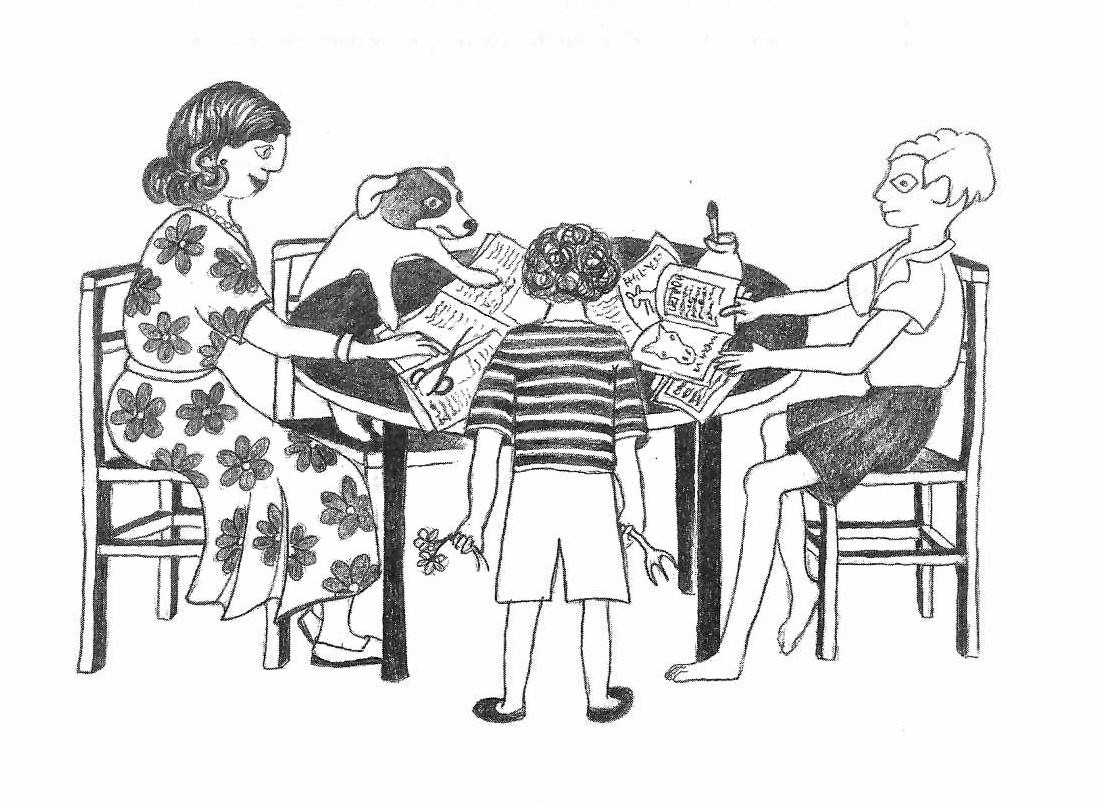
Nevertheless, every morning I would get up early to walk our terrier Judy to the Newsagents for the papers.  Back at the bungalow I would cut out all the news and photographs of the Derby horses, in particular from the Daily Graphic which had a photograph and form guide to a different Derby contender every day.  These I pasted into a scrapbook with loving care.


At this time it seemed almost everyone had a shilling each-way on their fancy in the Derby.  But since betting was then illegal, unless on the course or with a credit account, our family and everyone we knew placed their bets through an assortment of bookies runners, milkmen, hairdressers and publicans.



Gordon Richards, then the perennial champion jockey, had ridden the winners of every Classic race except the Derby. Having continually chosen the ‘wrong horse’ when his retaining stable had more than one runner, he was thought by the superstitious to have a Derby jinx.

This year however, was deemed to be ‘Gordon’s year’, for his Derby mount was the brilliant Tudor Minstrel.  Top of the Free Handicap the year before, Tudor Minstrel had recently won the Two Thousand Guineas by eight lengths in a canter from Saravan and Sayajirao.


On reaching the age of 11 earlier that year, I had got a job as a newspaper boy, and remembered the headlines ‘Horse of the Century,’ with further superlatives written around photographs of Tudor Minstrel, with arrows pointing to various parts of his anatomy.


Now certain to start at odds-on for the Derby, stories abounded about punters who had waded in to win fortunes before the Guineas. And such was the charisma that surrounded the horse and the Derby of that year, that 30 years later, after having my appendix removed, the man in the next hospital bed told me that he had taken 7-1 to a week’s wages about the horse, more than a year before the event.


All this hype however, had made very little impression on Aunty Kate, who insisted that Saravan would turn the tables on Gordon.  Mum liked to back a grey, so chose Migoli, Dad followed the Australian jockey Edgar Britt and hoped Sayajirao would win.  Nan fancied the Irish horse Grand Weather, on the grounds it had been the hottest week of the year, with people frying eggs on the pavement!


It was also decided that the dog should not be left out of the excitement and Merry Quip was chosen to be her runner. As we would not be back in time to get our bets on with our local hairdresser, a shilling sweep was arranged. But due to the considered reasoning that had gone into our selections, everyone wanted to keep the horse they had chosen, rather than risk the hazards of an orthodox sweep. And in view of my protest at missing the race, I was allowed to have Tudor Minstrel, but I had to put in the dog’s shilling to level up the odds.


The holiday continued in the usual tradition with trips to the beach where I played French cricket, made sandcastles and splashed about in a car-tyre’s inner tube for, despite the patient efforts of my father, I never learned to swim.


Returning to the bungalow in the evening, Mum and Nan would cook up some beans on toast, followed by tea and cakes. Dad and I would wash up and later a green baize cloth would be thrown over the table for a game of cards or dominoes.  Cards were a particular feature of our family evenings, with games such as Whist or Solo and, if there were more than four players, Switch, Newmarket, Race the Ace, Pontoon and Banker. These games were always played for small amounts of money to keep the interest alive.


On this and some other holidays, Auntie Mary, Uncle Henry and Cousin Peter would arrive for the day but stay over-night, sleeping on settees and in arm-chairs, to return the following day.  But always there would be cards in the evening.


One morning, Auntie Mary, seeing me pasting cuttings into my scrapbook, asked me who I thought would win the Derby and, on hearing of our sweep, wanted shilling tickets for herself, Henry and Peter.  However, on learning that all the fancied horses had already been taken, she had to be persuaded into taking two outsiders for the price of one.  She chose the two streets, Tite Street and Castle Street, ahead of Henry who picked two French horses, Cadir and Parisian. Henry had always wanted to go to Paris and, as he was on holiday, thought it a lucky omen.


When Peter, (aged seven), came in from the garden, he was asked to pick two horses from the remaining five.

“I’ll have Firemaster, ’cos I pass the Firestation on the way to school.  And has Merry Quip gone?” he chirped.

“Has it?” enquired Mary.

“Yes,” I said, “We picked that one for the dog.”

“Can you change it?” Mary asked anxiously.

“Not really,” I said, “We have written it down now and we don’t want to disappoint her.”

Peter, a stubborn little blighter, wouldn’t budge, for apart from liking the name he had been told at school that Tommy Weston, the jockey, had great faith in the horse.  To avoid tears, a compromise was agreed –  Peter was to pay sixpence and share Merry Quip with the dog.  Further discussions went on when it was known that I had already paid the dog’s stake, but no refunds were made.


As the holiday came to an end, so Derby Day loomed nearer.  The cases were packed, Judy given her last walk and the sea was said goodbye to for another year.  On the train journey home, no one spoke of the Derby.  But from 2.30 onwards, I began checking the time at ten-minute intervals, imagining first the saddling up, the paddock scene, and then the parade, followed by the canter to the start.  As the train pulled into Guildford Station I knew the race was over.  I now dreaded overhearing the winner’s name from a passenger’s casual conversation.

On arriving at Woking Station, we took a short taxi ride home.  Without any explanation from me or comment from my parents, I asked to be dropped off at Charlie Young’s Hairdresser’s Shop at the corner of our road.


Pushing into the smoke filled back-room where all the bets were taken, I blurted out to Charlie’s wife “Who won the Derby?”

“A French long-shot, Pearl Diver, 40-1,” came the reply.

“Second and third,” I squeaked.

“Migoli and Saya-watsit,” she responded.

“What happened to Gordon?”

“Led at Tattenham but didn’t stay; finished fourth”.

“Charlie won a packet on the race – says there’s a jinx on Richards in the Derby!”


Footnote:

For those who like a tidy finish, the sweep, not won, (Pearl Diver was the only horse under 200-1 that we hadn’t picked), was carried forward to the following year, when  Nan picked and backed the Aga Khan’s  My Love at 100-8.  As for my torture of missing the Derby, this only recurred twice in the next 53 years.


For more racing history see Michael’s Books for Sale

2022 Cazoo Derby – DESERT CROWN

Posted on:

244                             DESERT CROWN                          2022

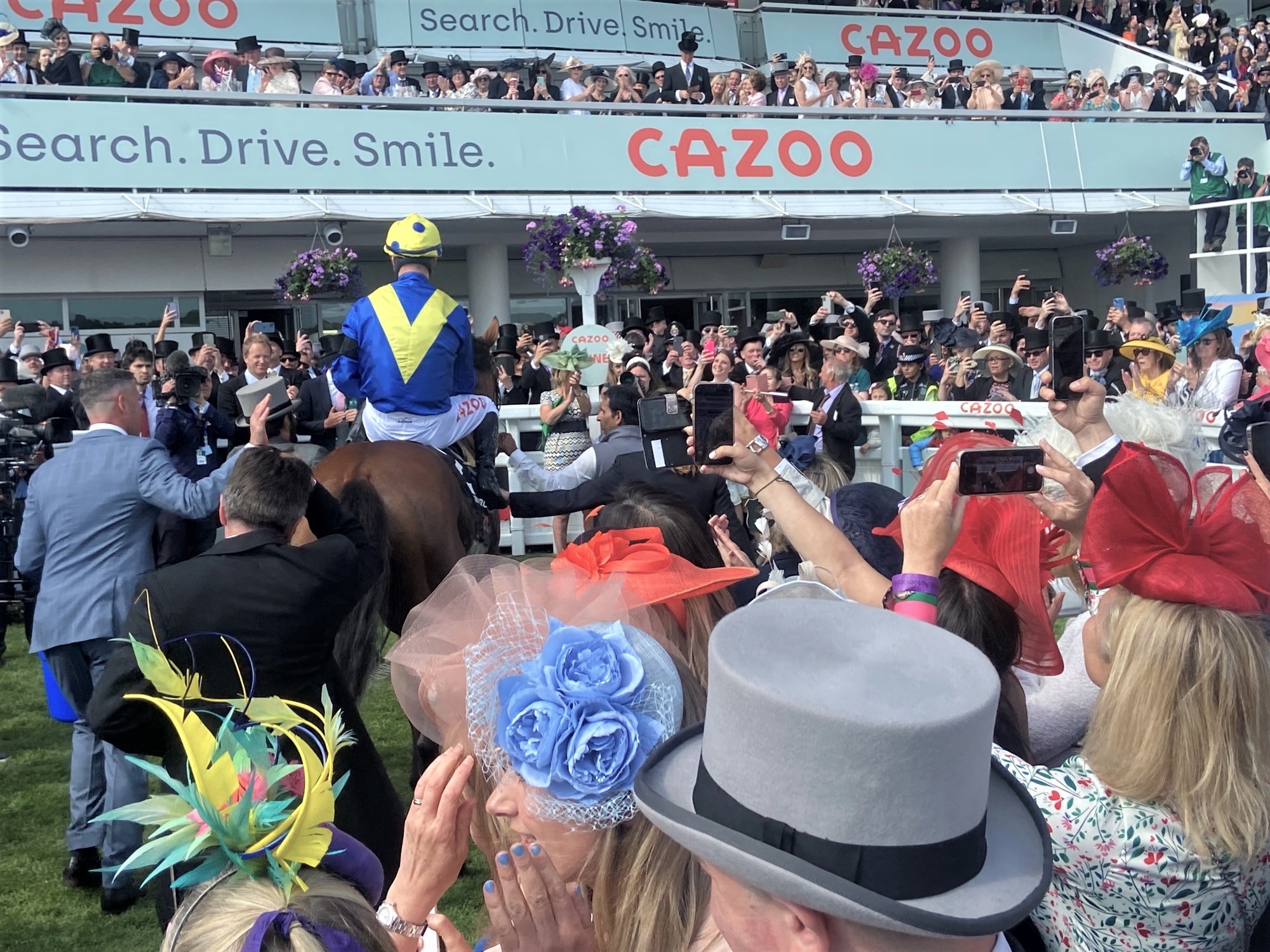
Run on Saturday, 4 June, 2022 as the Cazoo Derby (In Memory Of Lester Piggott) over the Derby Course of one mile and a half and 6 yards, Epsom Downs. For three-year-olds; entire colts 9st 2lb, fillies 8st 13lb.  94 entries. Value to winner £909,628.40


1st     DESERT CROWN   Richard Kingscote  5-2 Fav

2nd    HOO YA MAL       David Probert      150-1     2½ lengths

3rd     WESTOVER           Rob Hornby         25-1      Head


 Also ran: 4th Maskela (Andrea Atzeni) 66-1; Changingoftheguard (Wayne Lordan) 9-1; Stone Age (Ryan Moore) 7-2; Nahanni (Adam Kirby) 25-1; Nations Pride (William Buick) 15-2; West Wind Blows (Jack Mitchell) 40-1; El Habeeb (J. F. Egan) 250-1; Grand Alliance (Daniel Tudhope) 40-1; Piz Badile (Frankie Dettori) 9-1; Star Of India (Seamie Heffernan) 16-1; Glory Daze (Ronan Whelan) 66-1; Sony Liston (Tom Marquand) 100-1; Royal Patronage (Jason Hart) 28-1 (tailed off); Walk Of Stars (James Doyle) 11-1 (tailed off, last).


This year the weights for the Derby were raised 2lb to 9st 2lb, the first change since 1884.

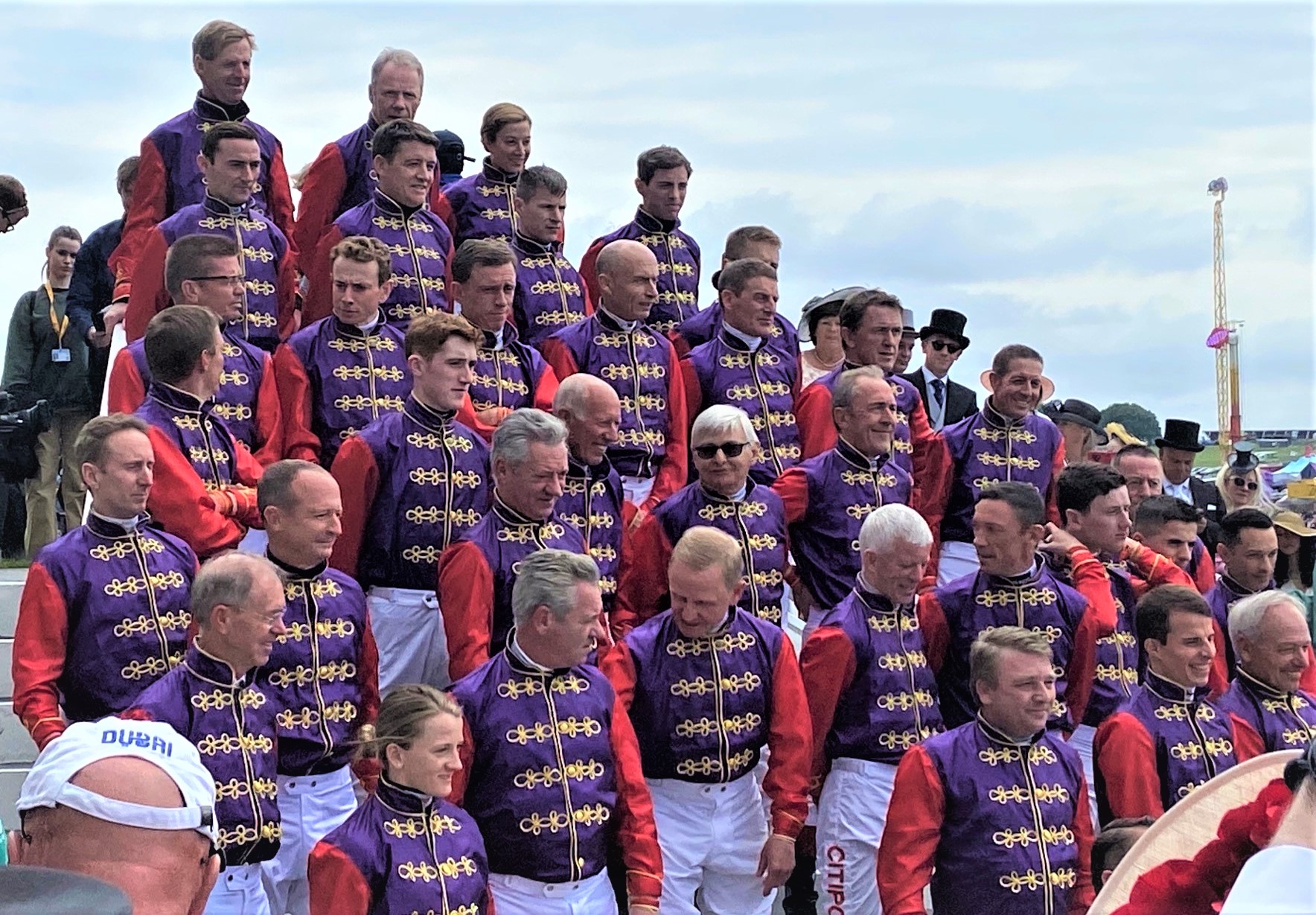
In the absence of Her Majesty, the Princess Royal headed the Royal Party and was greeted by the 40 jockeys who had previously ridden for the Queen.


 Desert Crown, an impressive winner of the Dante Stakes, headed the Derby betting at 5-2. Stone Age was a strong alternative at 7-2, as the pick of Aiden O’Brien’s three, having won the Leopardstown Derby Trial Stakes. While Godolphin’s Nations Pride, supplemented for £75,000 after winning the Newmarket Stakes by 7 lengths from Hoo Ya Mal drifted from 6’s to 15-2.

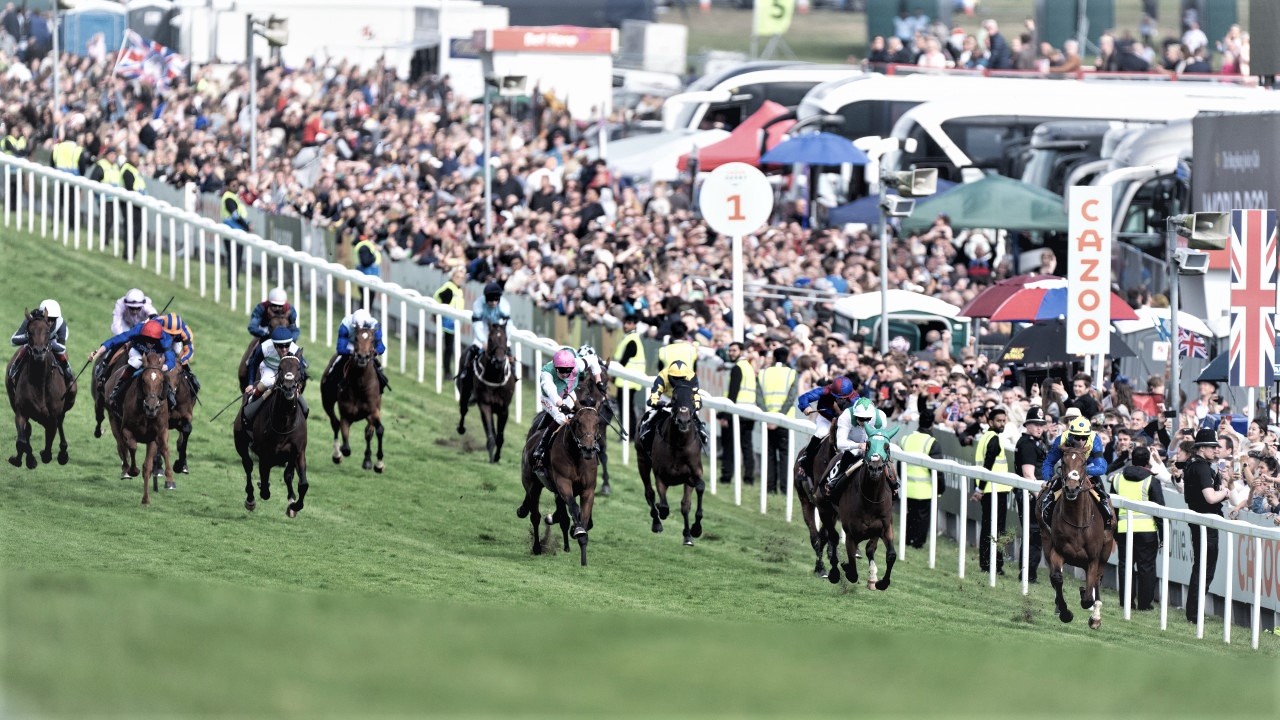
With Desert Crown the last to be loaded, the 17 runners got underway on good going. After 2 furlongs, West Wind Blows and Changingoftheguard took them along from Glory Daze, Star of India and Stone Age. At the top of the hill the front two maintained their lead while Desert Crown was nicely placed on the outside of the pack.  There was little change rounding Tattenham Corner until passing the 3-pole where Changingoftheguard gave way to HooYa Mal, while Desert Crown cruised up on the outside, Richard Kingscote sending him clear two furlongs out. Meantime, Rob Hornby on Westover, suddenly blocked by a closing wall of horses, had to pull out and round to make his challenge. Desert Crown by now 3 to 4 lengths clear and easing down with plenty in the locker, went on to win by 2½ lengths. Hoo Ya Mal, a 150-1 shot, held on to second by a head from the fast finishing Westover.

17 ran. Time 2m 36.38 sec


  • The winner was bred by Strawberry Fields Stud, owned by Saeed Suhail and trained by Sir Michael Stoute, his sixth Derby winner from Newmarket, Suffolk.


  The winner, DESERT CROWN, had won 3 races from 3 starts: EBF Maiden Stakes, Nottingham, Dubai Dante Stakes, York, Cazoo Derby, Epsom.

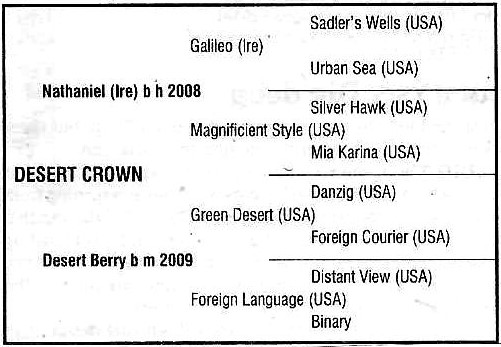
The sire, NATHANIEL b.c. 2008 by GALILEO ex MAGNIFICENT STYLE, won 4 races (from 11 starts): St Helens Maiden Stakes, Haydock, King Edward VII Stakes, Ascot, King George VI and Queen Elizabeth Stakes, beating WORKFORCE, (2011), Coral-Eclipse Stakes, Sandown. Sire of ENABLE, winner Investec Oaks, Darley Irish Oaks, King George VI and Queen Elizabeth Stakes, Qatar Prix de l’Arc de Triomphe (twice), Longines Breeders’Cup Turf , Churchill Downs.

The dam, DESERT BERRY b.f. 2009 by GREEN DESERT, won 1 race (from 3 starts): Forest Row Maiden Stakes, Lingfield (AW). She has bred 5 winners from 5 runners incl. FLYING THUNDER b.g. 2015 by ARCHIPENKO, won Premier Cup, Sha Tin.


Desert Crown and Richard Kingscote return in Triumph


A Tale of Two Cup Finals

Posted on:

A Tale of Two Cup Finals

This is a tale taken from my second book of short stories Born to Bet.


Uncle Charlie pulled his chair closer to the fire; the tale he told me seemed to come from the realms of fantasy, but he assured me it was true – it was of the events surrounding the 1923 F.A. Cup Final betweem Bolton Wanderers and West Ham United, the first at Wembley.


Arriving at the stadium early, Charlie and his brother Ernie were told the ground was full and the turnstiles closed.  However, along with thousands of others, they made their way into the ground illegally – in their case, up a very tall drainpipe and over a wall.


There was still an hour before kick-off, but when they got down the other side onto the terraces, they couldn’t move; 200,000 people the papers said, twice the ground capacity. Ernie had to get on Charlie’s shoulders to see what was going on; he said he couldn’t see the pitch for the weaving of heads, like bees swarming, but he could see, far away, a white horse.


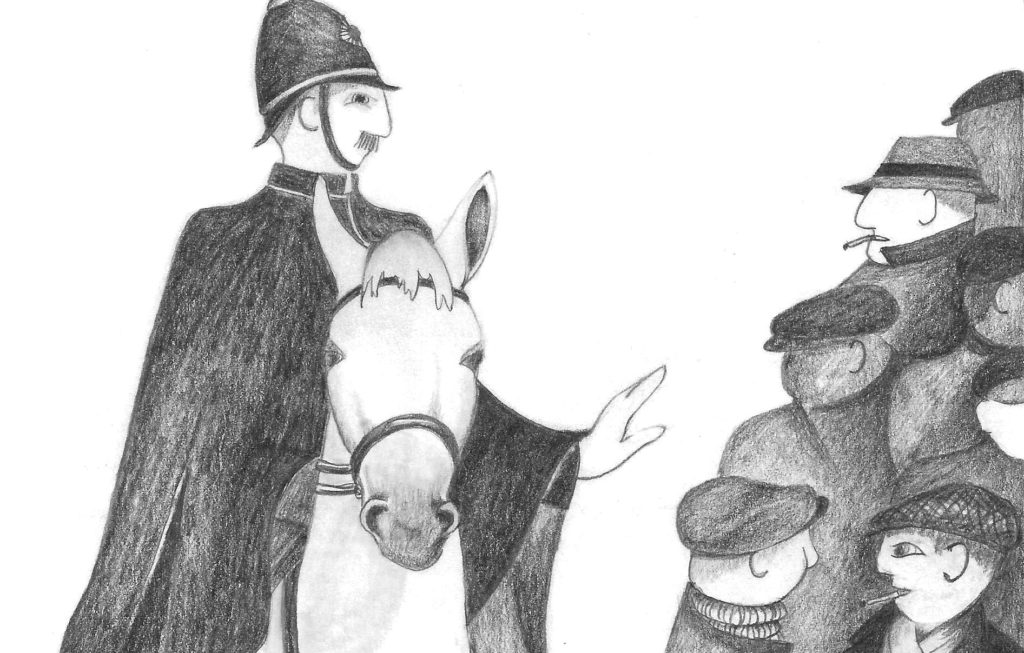
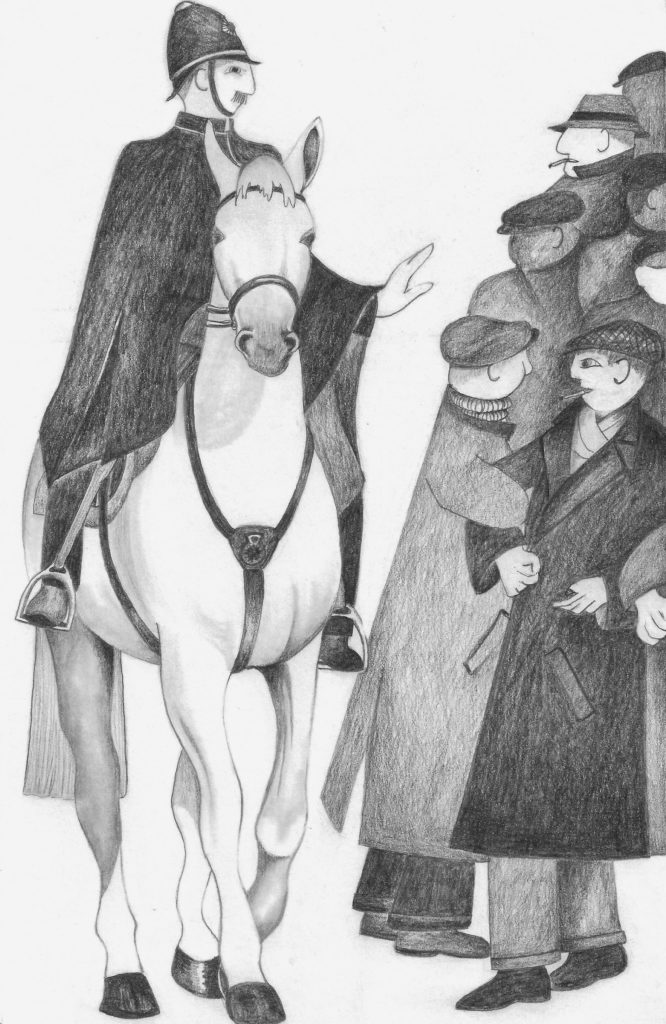
The copper riding Billy, as the horse was called, went around telling everyone to link arms and push back.  Forty minutes later, he and a squad of other coppers, some on horseback, had cleared the pitch, but only taking the spectators back to the touchlines.  In the meantime, Charlie said it was murder on the terraces, and when the game eventually started, he and Ernie had to take turns on each other’s backs to watch the game.


Charlie took up the story:

“We missed seeing the first goal completely, but the papers said that David Jack hit the first for Bolton with such force that it knocked a bloke over standing behind the goal who, in turn, knocked over a whole row of spectators like skittles.  And that wasn’t all. In the lead-up to the first goal, the West Ham right back, Tresadern I think it was, got trapped in the crowd after taking a throw-in, and while he was fighting his way back through the spectators, Bolton scored.”


At half-time the players were compelled to stay on the field, and around 10 minutes after the re-start, Bolton scored again.  But what a to-do! Vizard of Bolton received a pass from a spectator standing on the touch-line, before centering the ball to Smith, who vollied it so hard into the net that it hit a spectator behind the goal and bounced out again.  West Ham claimed it had hit the crossbar, but the referee gave the goal and Bolton won 2-0.  What King George thought of it all I don’t know, but I bet it didn’t take him as long as us to get home – just before ten o’clock, my Mum said !


Charlie’s colourful description of the match buzzed around in my head for days, until one wet games period, when Bill Long, our Games Teacher and incidentally Captain of Woking Football Club, asked if anyone would like to talk about a sporting event they had seen. No-one put their hand up, so I bravely asked if I could relate my Uncle Charlie’s account of the first Wembley Cup Final.  Long agreed.  I said bravely, as having a stammer, B-B-Bolton and Wer-West Ham were not for me the easiest of teams to pronounce.


The events of the game produced outbursts of laughter from the class, with Long occasionally interrupting my flow with,  “Is this true Church?” and  “Are you making this up?”  Well, I might have exaggerated the spectators collapsing like a row of dominoes, but I think my mates enjoyed it.


Two weeks later, there was a knock on our front door; it was Clarrie Jarman, a school-board inspector and the Secretary of Woking Football Club.

“Come inside Clarrie.”

Dad, a lifelong supporter of the club, welcomed him in, calling down the passage to my mother, “It’s Clarrie, Dorothy – put the kettle on.”

“No, no,” protested Clarrie, “I won’t stay long; it’s just that one of our Committee has returned his two Cup Final tickets and, I know it’s short notice, but I thought you and Michael would like to go.” He handed Dad an envelope.

“They’re not too expensive; three shillings (15p) each. It’s Manchester United and Blackpool on Saturday,” he added unnecessarily.

“By the way,” he told Stan, going to the door, “I hear young Michael gave a great account at school of your brothers’ visit to the ‘White Horse Cup Final’.”


Next day at school, I could think of nothing else, but fearing a jealous reaction, I decided not to tell anyone.  Then, after the last lesson on Friday afternoon, I went back to my classroom to collect my satchel. Bill Long was there, busy wiping off the blackboard with a duster, until interrupted by the Science Master, who came in to wish him a good weekend.  Glancing up, I noticed the blackboard now read “B—–2 and underneath MU—–4.”  Obsessed with thoughts of the Cup Final, I interpreted this as Blackpool 2 Manchester United 4 – an omen.  When I drew Long’s attention to it, he laughed, saying, “No, no, no, that was Biology – period 2, Music – period 4,” adding, “Anyway Church, have a nice weekend and you can tell us about the game on Monday!”


Returning home, I sensed the excitement was building up.  Mum had bought my first pair of long trousers, and Nan produced a new thermos flask – a tartan one from Woolworth’s – for the journey.  After tea, Dad propped the two tickets up either side of the mantlepiece clock.  We looked at them long and hard – the date read 24th April 1948.


In the morning, Dad went out and bought all the newspapers for my scrapbooks.  I was at this time a follower of Blackpool and of their international stars, Stanley Matthews, Stan Mortensen and Harry Johnston.  Naturally, Dad and I had a few bets on the correct score.  I had two shillings on Blackpool to win 2-0 and 3-0, but after telling Dad about the blackboard omen, we felt it prudent to have two bob each on Man U. to win 4-2. The odds were 50-1.


The first half of our 40 minute train journey was taken up with Dad helpfully trying to pin an orange and white rosette securely onto my coat. Alighting at Waterloo, he was approached by a spiv ticket-tout, who offered him £5 each for our three-bob tickets – more than thirty times the price.  This took Dad by surprise and for what seemed an age, he stood dithering in shock until, after looking across at me, he sent the tout packing.  I later learned that Dad’s weekly wage was £9, so the tout’s offer was a massive temptation.


Inside Wembley stadium we located our position on the terraces – high up, overlooking one of the corner flags. The whole area was uncovered and the Tannoy system was difficult to hear, but I do remember the famous Arthur Caiger, in a white boiler suit, standing on a rostrum in the centre circle conducting Abide With Me, after both sets of supporters had given a full throttle rendition of Lassie from Lancashire.  Finally, we were all asked to wave our song sheets for the cameras, a shot that the newsreels repeatedly used after a goal was scored.


Compared with Cup Finals today, it was a very strange experience; being so high in the crowd with only the sky above, it was comparatively quiet. There was no chanting and singing during the match as today, but the more dedicated fans would have wooden ‘air-raid’ rattles and some would have hand-knitted scarves with their players’ names stitched onto them.  Most of the men, and they were more than 95% of the crowd, would shout out in desperation phrases like “Unload him Harry”, or “Fire it over”,  “Let him have it”, or  “Shoot” – all echoes of the recent war.


Up the other end, about a mile away, Blackpool scored from a penalty, but from where we stood, it seemed to happen in an eerie silence.  I, of course, shouted “goal!” and jumped up and down, but there was little emotion around me and I remember how surreal the experience felt.  In those days, almost two-thirds of the tickets went to clubs that had taken part in the earlier rounds, right down to the amateur clubs like Woking and Corinthian Casuals, so the strong partisan feelings of the teams supporters were confined to certain areas.


History has it that Jack Rowley of Man U. equalised after 27 minutes, before Mortensen, courtesy of a Matthews free-kick, put Blackpool 2-1 up at half-time.

It was difficult to sit down on the terraces, but we managed it, eating our sandwiches of corned beef and lettuce from the garden, washed down with tea from our new flask.  Meanwhile, the breeze blew in an occasional piece of music from the brass bands playing below.  Dad said he recognised his old favourite,  “The Standard of St George”.


Blackpool’s lead evaporated in the second half, and I remember the men on a gantry, way up behind the goal, changing the enormous placards against the teams’ names to 2-2, then 2-3 and finally 2-4 for United.  One lasting memory was of United’s Charlie Mitten, racing down the wing and repeatedly crossing the ball into the Blackpool goalmouth.


Eventually, we all drifted away. I felt very dejected, but Dad did his best to cheer me up.  Then suddenly, I checked my betting slip and saw: Man U. 4-2 at 50-1.  It seemed like a light in a dark tunnel – brilliant!  Walking back down the Wembley Way, we checked our winnings – £5 each – the same amount the tout had offered us for our tickets.

Dad thought it was an amazing coincidence, and so did I.


Ascot’s Festival of Britain Stakes 1951

Posted on:

The Festival of Britain Stakes


 With the Investec Derby, Oaks and Royal Ascot behind us, I’d like to tell you a short story about my train trip to the first running of Ascot’s King George. Billed as the Festival of Britain Stakes, with more prizemoney than the Derby, it was heralded as the race of the year.  


Amid the noise and excitement, a crowded train pulled into Clapham Junction; it was one of many that day leaving for Ascot races.  This was Festival of Britain year 1951, and racing’s contribution to the festivities was a new race – the King George VI and Queen Elizabeth Festival of Britain Stakes. Everyone seemed to be talking about it and everyone wanted to be there.  On top of that, it was one of those days of characters and mysteries that were to sink sublimely into my youthful memory.  Clambering aboard, I squeezed into a train filled with cigarette smoke and swaying bodies.


“There’s room for a nipper over here,” a large lady beckoned – I squeezed in. Her bright blue turban and flowered print dress contrasted dramatically with the sombre utility suits of the four men facing me. Directly opposite was a pale-faced man, fortyish, with dark crinkled hair, who I later learned was Mori. Turning to his neighbour, who looked ex-RAF and sported a ginger moustache, he said, “I’ve got a jacket at home that will fit you perfectly.”

“Sounds good,” said the moustache. “How much do you want for it?”

Mori paused, “If it fits you, it’s yours, free, gratis,” adding, “when you’ve had a winner you can pay me for it.”

“You see John’s jacket,” he continued, turning to the battered trilby on his right, “that’s one of mine. How long have you had that John?”

John frowned and took a sharp intake of breath.

“Must be 25 years now.”

“You see – quality,” beamed Mori. “Your brother’s got a similar jacket hasn’t he John?”

“Yes, he has sometimes.”

“What do you mean sometimes,” retorted Mori, now fully in command of the quartet.

“Well, he has it when I let him borrow it,” said John.

“You and your brother are a mystery to me,” continued Mori.

“Tell me, how is it you’re 50 and your twin brother says he’s nearly 60?”

“Ah,” said John, “He lies about his age!”


At this point, Reggie, their fourth member – egg-stained tie, and pebble glasses – looked up from his window seat, where he had been engrossed in The Sporting Life.

“Er John, isn’t that the jacket that your Mum wanted to bury your Dad in?”

Richmond – Twickenham – Feltham, the train was now heaving and a further gaggle of passengers stood between the two rows of seats in our carriage, temporarily depriving me of this surreal banter. And it was not until two of them found room in the corridor, that I tuned in again to the moustache opposite.

“Flat on the floor I was, threatened with a shooter – then they blew the safe – I couldn’t stop shaking, but when they opened it there was only a monkey inside.”

The blue turban chuckled and her fag-ash went all over my lap.

“Sorry darlin’,” she exclaimed, “but you gotta laugh, ain’t yer?”  And she did, like a drain.


At Staines, two bottled beers got in, and after passing the Daily Herald to and fro, a Fairisle pullover enquired of Mori, “Er, mate, lend us a pen for a sec.”

“Sorry,” said Mori dismissively. Whereupon, the Fairisle bothered everyone in turn for something to write with.

Finally, the blue turban offered him a crayon, which she later told me she had used to draw stocking seams on the back of her legs. Meanwhile, it was obvious, even to me as a 15-year-old, that the two bottle beers were a con-act, supposedly marking in that day’s stable whispers.  And sure enough, as soon as we were pulling into Ascot station, I heard the Fairisle say to the ginger moustache, “Five bob and I’ll mark yer card.”

Hastily grabbing my brown paper bag from the luggage rack, I didn’t look back to see if the fish was landed, as by now, I was being swept along the platform by the crowds that spilled out from every door on the train.


Down the underground tunnel and out into the light, we were met by all manner of tipsters, vendors and entertainers along the footpath to the racecourse. And it was not until I had reached my vantage point in the middle of the course that I stopped to unpack my lunch: two loose bananas, The Sporting Life, a bottle of Stout and, a pair of pyjama bottoms – I had grabbed the wrong bag!   Always the opportunist, I managed to make use of the first three items, but I had to admit the fourth had me stumped.  More importantly, who had got my mother’s Opera glasses and the cheese and pickle sandwiches she had so lovingly packed? My mind went back to the carriage; which of them was likely to take pyjamas to the races?


But now there were more important riddles to solve, as 18 two-year-olds went to post for the first, over the straight six furlongs. Soon after, Gordon Richards came back to tremendous cheering on the favourite, Olympic.  Half-an-hour later, Scobie Breasley did favourite backers another good turn, when the filly, Verse, won in a photo finish.


Moving over to a spot opposite the paddock, I watched the best horses in Europe filter out on to the course, for what was to be the first ‘King George’. Its prize of £25,000 was the richest ever for a British race.

The favourite was the Derby winner Arctic Prince, while the opposition included Tantieme (Prix de l’Arc de Triomphe), Scratch (St Leger), Supreme Court (King Edward VII), Belle of All (1,000 Guineas), Ki Ming (2,000 Guineas), Sir Winston Churchill’s grey, Colonist, and the temperamental  Zucchero with the 15 year-old Lester Piggott aboard.

Nineteen runners went to post before a crowd reported to be more than 100,000.

I had taken an array of bets from my school-mates on the race, including two doubles running-on from Olympic to the long-shots Belle of All and Ki Ming, but refusing to hedge-off, I stood my ground.

Without a public commentary, or my Mum’s opera glasses, it was hard to know what was going on, but a tall man standing on a hillock nearby shouted out that Wilwyn and Belle of All were leading, and even I could see the grey, Colonist, up with the leaders.  But along the home straight, two horses pulled away from the rest – the electric atmosphere and the tremendous roar from the crowd gave me the feeling of being in the middle of a great storm, although in reality it was a bright sunny day.

Finally, I could see Charlie Elliott in the colours of Supreme Court – scarlet with a white V – get the better of young Lester on Zucchero. Both horses broke the 30-year-old course record.

Having weathered the storm, I realised that no-one at school had backed Supreme Court, so, to celebrate I bought a jumbo ice-cream cone and washed it down with the bottle of stout. Nevertheless, still in the possession of an unwanted pair of pyjama bottoms and, without an immediate use for them, I decided to let them loose in the makeshift lavatories.  On my way out, I saw a huddle of men gathered at the exit.  Not the usual ‘Find the Lady’, but Banker!  Suddenly, I was joined by the Fairisle pullover.

“Had any winners”, I piped up.

“Oh, hello titch, weren’t you on our train?”

“Yes,” I said, then pressing, “How are your tips going?”

“Oh, those,” he grinned, “just out to make a bob or two, you know.”

“Were they really stable whispers?” I persisted.

“Nah – just a couple of favourites and some my old Mum picked out – double-barrelled names with the same letter, you know, Fast Fox, that sort of thing,” he said with surprising candour.


Spilling out into the light, I was confronted by a cockney balloon salesman.

“The more yer blow, the bigger they grow,” he proclaimed. And then, as a small gathering of children surrounded him, he proceeded to make a series of giraffes, poodles and dachshunds from blowing and twisting balloons.

“One shilling for a giraffe,” he announced, “start your own zoo today.”


A further two races passed – Fast Fox 7-2 and Lancashire Lassie 13-2.  The Fairisle’s Mum certainly knew a thing or two!

Drifting through the crowd and feeling a little thirsty, I went into the beer tent to try and get another bottle of stout, but after standing on tip-toe for five minutes in front of a bar, now five deep, I heard a voice behind me say: “You’ll be lucky, nipper.”  It was the blue turban, who surprisingly had linked arms with the ginger moustache from our carriage, introducing him as Ralph and herself as Betty.  Both seemed very jolly, as Ralph, having paid five-bob for the Fairisle’s tips, had backed three winners. Betty snuggled up to him and told me she was going to help him spend it.

Eventually, Ralph got to the front of the bar and ordered me a beer. Standing in a corner of the tent, Betty mused, “I brought a bottle of stout with me, but must have picked up the wrong bag – still the sandwiches came in handy.”

What could I say? I couldn’t ask her about my Mum’s opera glasses, or the subject of the pyjama bottoms would crop up. I didn’t feel equal to that discussion, so I kept quiet, but my mind ran riot with bizarre images of their employment.

After another round of drinks, courtesy of Ralph’s success, we dashed out to back the favourite in the last. Wanting to look big, I had a £1 on it, while Betty was urging Ralph to double his stakes. Inside the final furlong, the favourite Pares, and Red Linnet (the danger), were up-front going hammer and tongs. I confess I had to look away, but I could hear Betty screaming and then noisily kissing Ralph.


It had been a great day for all of us. We collected the cash and walked back to the Railway Station, where we met up again with Mori. He seemed a little quiet however, and declined the offer to accompany us to White City dogs. Ten minutes later, having talked about our varying degrees of success, we boarded the London train together.

Mori looked tired, and sank back into the corner seat. After a few minutes of staring blankly out of the window, he sighed and said,

“Life’s like a game of poker you know; most people are dealt a hand for life – I think mine was a pair of Jacks.  Not great, but when the opposition is weak or they hesitate, you can pick up a few quid. Some good times, some bad and, if you like what you’re doing, even the bad times are good.”

We all nodded respectfully at his obscure soliloquy. I guessed that Mori was coming to terms with a very bad day.